Split things to do: Detailed overview of historic attractions, beach recreation, nightlife, shopping and local cuisine with transport routes, prices and personal travel impressions
Updated:
This is a place you’ll always want to return to. Hundreds of thousands of tourists who visit Split every year – one of the most important and touristic cities in Croatia – leave with this feeling.
Split is a convenient city to visit. It’s very well connected with the rest of the country as well as with neighboring Italy. It has everything a traveler might need: attractions for every taste (both man-made and natural), pleasant climate, and cuisine you fall in love with from the first dish.
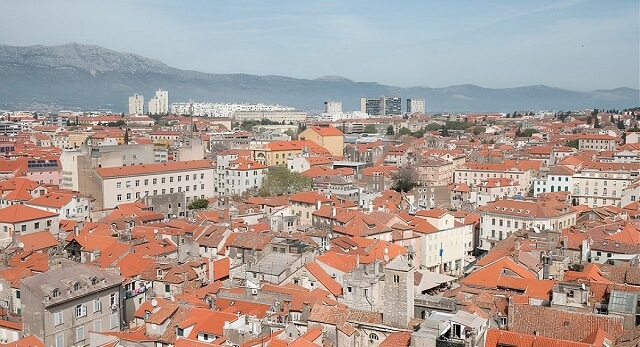
Red roofs to the horizon, on the horizon – gray multi-story buildings from Yugoslav times, and behind them – mountains!
Contents
The city of Split in Croatia: where it's located and what makes it special
Split is quite a large city by Croatian standards (178,000 inhabitants) in the Central Dalmatia region. In fact, it was built around the palace of Roman Emperor Diocletian, which, in turn, was originally built for his old age. Thanks to this, walking through the historic center of Split, you can admire Roman walls, squares, and temples.
Split is the second largest city in Croatia (after the country’s capital – Zagreb), located on the Marjan peninsula, between the Split Channel and Kaštela Bay, at the foot of the Mosor mountains. This is the southern part of the country and the central part of the Croatian coast, between Dubrovnik and Zadar.
Split is an excellent option to start your journey through the cities of the Adriatic. The mixing of styles is very noticeable in the city, as during its seventeen-century history it belonged to the Roman Empire, Byzantium, the Venetian Republic, Austria, and Croatia.
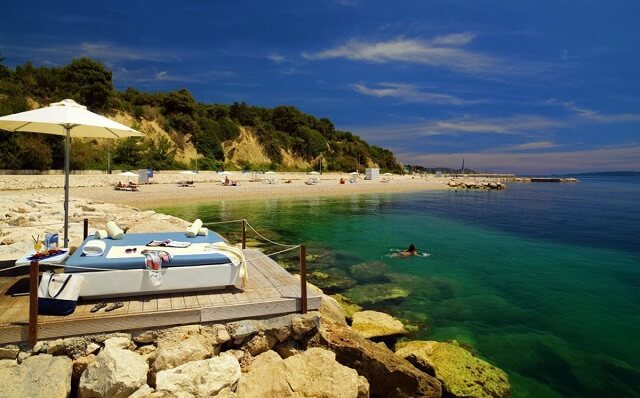
Also, Split is attractive for the cleanest sea in Europe. Here it has a bright turquoise color and transparency: standing in the water, you can see the bottom at a distance of 20-30 meters from you.
How much does accommodation cost in Split?
Hotels and guesthouses. Here even in the summer season you can rent a double room for 20-25 euros, but at this price options are available with low ratings (about 6 points) and in remote areas. In the central part of the city, good options can be found for 30 euros, and in the Old Town itself you’ll have to pay at least 50 euros. In the off-season, prices are significantly lower; even a hotel room in the Old Town can be rented for 30 euros (for example, Inn The Heart Of The Palace).
Hostels: in summer a place in a shared room will cost from 11 euros and up. In the Old Town, most hostels offer places for 18-19 euros. In the off-season, even hostels in the very center with good ratings rent out places starting from 9.5 euros (for example, CroParadise).
Airbnb: an apartment in the Old Town for summer needs to be booked as early as possible; prices start from 55 euros. As an alternative, there are always apartments in adjacent areas for 50-60 euros. In season, rooms cost slightly less – about 45 euros, but in the off-season prices drop and for 25-30 euros you can rent an excellent room in the very center.
Thus, good budget accommodation in Split will cost you 9.5-15 euros per night per person.
Split districts: where it's better to stay and where to walk
Split Old Town
You can enjoy such views every day if you settle in the Old Town during your vacation
This city district is declared a UNESCO World Heritage Site. This means that if you stay in the historic center of Split, you’ll have the opportunity to live surrounded by many of the most important and well-preserved Roman monuments in Europe. In addition, this is the district with the largest number of accommodation options for tourists.
The most significant attraction of this Split district is undoubtedly Diocletian’s Palace; a monument from the Roman Empire that began to be built in the third century AD. Today it is a true open-air museum.
The Old Town is a very touristic district; at the same time, it has everything necessary for a tourist: shops, restaurants, hotels, hairdressers, and tourist offices. Despite the atmosphere prevailing here, it’s quite a quiet and safe area. You can walk calmly and comfortably through its streets even late at night.
Bačvice district
The Bačvice district got its name from the city beach located right here. It’s located on the shore of the small Ferris bay, located south of Split port. This is a district that combines tranquility and vibrant nightlife. A large number of villas and private houses have been built here, many of which can be rented for vacations.
Bačvice has good transport connections with other areas of Split, thanks to which both tourists and locals come here en masse for beach recreation. Bačvice beach is awarded the blue flag, which is awarded to the best beaches in Croatia. There are many beach bars here; moreover, this is one of those places where some of the best restaurants in Split are located.
It will be convenient to settle here for those who want to be on the beach more often and at the same time lead an active nightlife.
The sandy beach of the same name in the Bačvice district
Stobreč district
If you’re looking for a quiet area, away from the hustle and bustle, Stobreč is what you need. Among the main advantages of this district is a large variety of accommodation options. Here you can stay at a campsite (Camping de Stobrec) as well as in more comfortable locations (apartments, budget apart-hotels, and high-class 4-5 star hotels).
On the other hand, in this district, located about 8 kilometers from the center of Split, you can enjoy magnificent rural landscapes. There are two excellent beaches in this area: Kam and Stobrec. They are located in the northeastern part of the district, with Kam located right in front of the campsite, and Stobrec a little east of it.
Here, as everywhere in Split, there are many restaurants, and on the shore – a large number of beach bars for every taste and budget. At night it’s pleasant to drink wine by the sea to the accompaniment of live music of different styles.
Stobrec is considered an inexpensive district to stay in and is ideal for those looking for a beach holiday and relaxation without the need to walk a lot.
Žnjan district
There are two factors that characterize this district: on one hand, it’s Split’s most famous beach (here there’s an opportunity to dive with a mask and scuba gear, as well as rent boats and jet skis); on the other hand, high accommodation prices.
Most hotels located here have 4 and 5 stars, and the price per night is on average about 150 euros.
The Žnjan district is located east of Split. It has very good transport connections with other main areas of the city. Therefore, living here you can sunbathe on the largest beach in the Split area and without much problem visit the city’s most famous attractions, after which in the evening enjoy the rich nightlife of the Žnjan district.
Marjan district
Marjan is that very place in Split from where you can see the whole city, as it’s located on top of a hill 180 meters high. The district has several marinas and beautiful beaches, which undoubtedly attracts crowds of tourists coming to Split.
In the marinas, you can rent pleasure yachts for independent travel or buy a ready-made excursion to various islands located in the waters near Split. Here you can also enjoy walking in a beautiful park (Šuma Marjan Park).
Quiet bay on the edge of Marjan Park
If you want to combine beach holidays and island excursions with cultural leisure, you can always visit the archaeological museum and science museum, as well as the Mestrovic art gallery.
Of course, this is a place where there are many restaurants and nightclubs. From the Marjan district, it’s convenient to get to the central areas of the city, both on foot and by bus.
Public transport in Split: routes and prices
Map of city routes of the operator company Promet Split
If everything is more or less simple with routes (there are schemes), then it may be more difficult to figure out the schedules, as they always indicate departure time from the terminus, and most often – only from one of two possible.
The same schedules hang at stops (i.e., the time indicated in the schedule may have nothing to do with the actual arrival time of the bus at this stop), and in most cases there is no information at all at the stops: it’s even unclear whether buses come there at all or not.
Fortunately, buses are practically not needed in Split itself; they run frequently to Salona, and only the Klis fortress will require some skills in using Croatian public transport.
Many buses depart from the suburban bus station Sukoišan, for example to Trogir (No. 37) and to Omiš (No. 60). Some others go right through the city: useful stops are at the market and near the national theater.
How much does a city bus ride cost in Split?
Public transport routes in Split are divided into four transport zones. Accordingly, the ticket price depends on the tariff zone:
Split itself – first zone,
Salona and Klis – second zone,
Kaštela – third zone,
Trogir and Omiš – fourth zone.
The easiest way is to take a ticket from the driver; this costs from 0.7 euros for one zone to 1.5 euros for all four transport zones.
You can also buy tickets at kiosks, for example, Tisak or Slobodna Dalmacija. At a kiosk, a ticket for one zone costs 0.5 euros; other transport zones cost the same as from the driver. Kiosks also sell tickets for two trips and carnets for 10 trips (5 x 2), which give some benefit if you’re traveling more than one zone.
Travel passes are sold only for a month; their cost is 18.5 euros within the first zone.
When boarding the bus, the ticket must be validated either on the yellow validator or with the driver. Transfers are possible during the trip: a validated ticket for one zone is valid for 45 minutes, for 2 – 65 min., for 3 – 85 min., for 4 – 105 minutes.
Fine for unpaid travel (unvalidated ticket) – 3 euros.
How much does a taxi cost in Split?
Taxi prices in Split may differ depending on the company, plus rates are higher in summer. In summer, boarding costs an average of 2.7 euros, and a kilometer of the journey costs about 1.3 euros. In winter, the minimum trip cost is 4.0 euros; this amount includes travel for 3 kilometers, each subsequent kilometer will cost 1.1 euros.
How much does gasoline and parking cost in Split?
A liter of 92 gasoline in Split costs an average of 1.2 euros. In the central part of Split (zone 1), street parking costs 0.7 euros per hour, parking time limit – 2 hours. The most expensive parking is on the embankment (Riva) – 1.3 euros for the first hour and 2.0 euros for each subsequent hour.
5 main attractions of Split
Modern Split consists of road junctions, overpasses, green parks, cruise liners, shopping centers, a stunning embankment with a forest of yacht masts, and a cozy historic center.
The entire historic part of Split, the old town, is a pedestrian zone and is essentially a labyrinth of narrow streets. You can just wander the streets or go down to the excavations at the base of Diocletian’s Palace.
Central entrance to Diocletian’s Palace
Diocletian’s Palace is attraction #1 in Split, which is impossible to pass by. The palace is surrounded by a high wall that seems to whisper “there’s something interesting behind me…”. And also, seasons 4 and 5 of “Game of Thrones” were filmed in Diocletian’s Palace.
The most interesting things in the palace are the Cathedral of St. Duje, the Temple of Jupiter, and the peristyle.
On the left you can see the bell tower of St. Duje or St. Domnius, and on the right – the entrance to the palace cellars
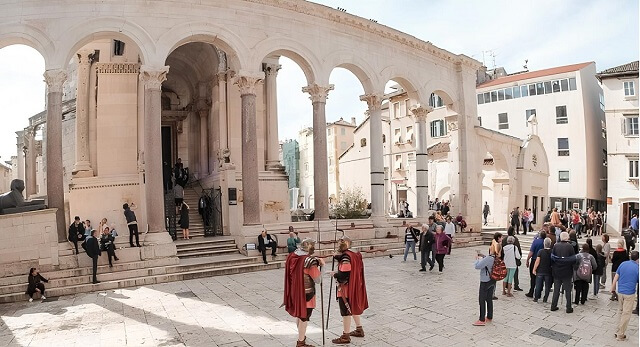
The peristyle is the inner palace square. The Romans used it for ceremonial ceremonies. The square is small, surrounded by columns.
By the way, exactly at noon, at 12:00, every day in Peristyle Square a small performance takes place. Men dressed like Roman warriors start trumpeting.
This is what the Peristyle looks like during the day (the stairs lead to the entrance to St. Duje Cathedral and the bell tower)
St. Domnius Bell Tower. Passage to the bell tower costs 3 euros per person. The main charm of the bell tower is the opening views. Inside are bells that are over 300 years old!
The main catch of the bell tower is the staircase leading up. It seems to be made solidly, doesn’t shake, but still your heart sinks. For those who are afraid of heights, it will be a test. But it’s worth climbing; the main thing is not to look down.
The main charm of St. Domnius Bell Tower is the opening views
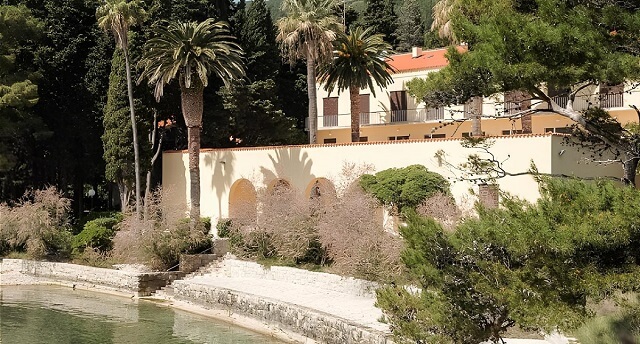
Villa Dalmatia – the former residence of Yugoslav ruler Tito. Often the villa is called “Villa Tito.”
On the internet they write that the villa is not guarded, but this is not true. At the gates you’ll be met by a guard with a sleepy face. He told us that it’s very dangerous there and it’s impossible to go inside. Not all doors open on the first try, and some are easier to go around.
On the villa grounds it’s very quiet and deserted. And everything looks a bit neglected, as if no one is taking care of it.
It seemed to me that the only inhabitants of the villa are a couple of cormorants warming themselves on the rocks. Perhaps they are precisely the danger the guard was talking about? Fear and horror.
On the villa grounds it’s very quiet and deserted and everything looks a bit neglected
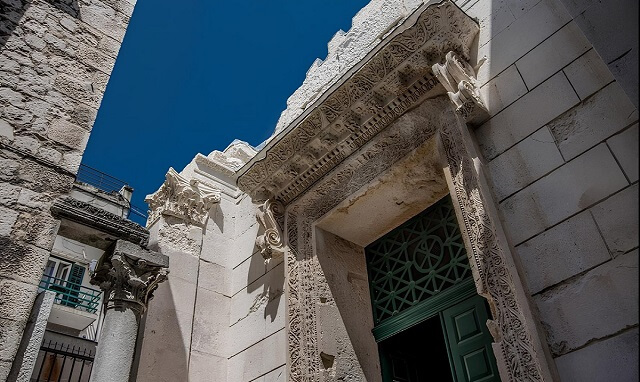
Temple of Jupiter – entrance here costs 0.3 euros. A magnificently preserved ancient Roman temple that was built in 295-305 AD by Emperor Diocletian. The entrance to the temple was decorated with two sphinxes made to special order.
Later, with the arrival of Christianity in Dalmatia, the temple was converted into a baptistery (Krstionica sv. Ivana Krstitelja), and the crypt was named in honor of St. Thomas. Inside the temple are tombs where local archbishops John and Lawrence were buried, and an 11th-century baptismal font, on one of the marble slabs of which the oldest images of Croatian King Krešimir IV are engraved.
Inside the temple there’s also a statue of St. John created by Ivan Meštrović in 1954. Now only one sphinx remains near the temple.
Temple of Jupiter
Cost of visiting museums and attractions in Split
Prices for entrance tickets to museums and attractions in Split vary. For example, a ticket to the Ethnographic Museum or St. Domnius Cathedral, as well as to its bell tower, costs 2.0 euros. A ticket to the City Museum will cost a little more – 2.9 euros. Expensive museums include the Meštrović Gallery – 5.3 euros, as well as the dungeon of Diocletian’s Palace – 5.6 euros.
Ethnographic Museum exposition
Split beaches: is it worth coming here for a beach holiday?
Comfortable beach recreation areas are located both directly in the city and beyond. Thanks to the well-organized transport infrastructure, you can easily get to any of them, regardless of where you settled in Split.
Split beaches are covered predominantly with fine pebbles. The sea water is impeccably clean, turquoise in color, visibility in depth – up to 50 meters. It’s quite difficult to answer unambiguously the question: “which particular beach to prefer.” Each is distinguished by a special atmosphere, infrastructure, and beautiful nature.
The most iconic, popular, and visited beach both in Split itself and throughout Croatia is Bačvice beach. Its main distinction is sandy coverage and excellently developed infrastructure.
Bačvice beach is the traditional leisure place for the city’s youth and numerous guests. The discos and beach festivals of Bacvice beach are famous far beyond the city of Split.
Trstenik beach
Next to it is another beach – Trstenik, already covered with fine pebbles. If you’re vacationing at Bačvice, you can easily get to Trstenik via a pedestrian path.
Even further, the territory near the Radisson hotel is equipped. You can relax here for free, using the necessary infrastructure – sun loungers, shower; here you can have a snack at a cafe.
Radisson Hotel beach
The hotel territory smoothly transitions into the resort’s longest beach – Žnjan, an excellent place for family recreation. Here there are many attractions, both for children and adults; there are sports grounds, trampolines, and slides.
Comfortable pebble beaches also include Kaštelét, and at Ježinac there are green plantings that provide pleasant shade on the shore.
Kaštelét beach
When to come to Split?
It’s worth coming to Split for two days; at the same time, due to the influx of tourists, it’s better to avoid summer. From a weather point of view, it’s optimal to come at the end or beginning of the season, that is, in May or September. Moreover, in May the day of St. Domnius – the patron saint of Split – is celebrated, and in September the new film festival takes place.
The main charm of summer in Split is the Splitsko ljeto festival, which features exhibitions, theatrical and opera performances. Also in August, the Split Beach Festival dance music festival takes place.
Shopping in Split
In Split, as a fairly large resort city with 220 thousand inhabitants, there are all opportunities to occupy your free time with shopping trips in search of souvenirs, jewelry, clothing, and other goods.
This city is conditionally divided into two parts – old and new. The most suitable area for shopping is the Old Town, where small shops with all sorts of things are lined up in a long row. They sell cheap clothes and shoes, jewelry, and accessories.
On the very long Marmontova street, international chain stores are located. In Split shops selling locally produced goods, bargaining is quite appropriate. Split has fairly low prices on local products, clothing, and even sometimes on jewelry. If you didn’t bring swimwear on your trip, drop by the street behind the “Stari Pazar” market – these items are sold there at quite low prices.
Marmontova street is famous among shopping lovers – here are stores of well-known brands
How much does food cost in restaurants?
Lunch at an inexpensive cafe: 8.0 euros. For example, Buffet Zlatna Ribica
Fast food:
čevapi 3.3 euros. For example, Kantun Paulina
piece of pizza 2.0 euros
Drinks:
cup of cappuccino 1.6 euros. For example, 4coffee soul food
glass of beer 2.4 euros.
How much do products cost in supermarkets?
Prices in Split for products are slightly less than a third higher than Moscow prices. Prices for fruits and vegetables, alcohol, and dairy products are even slightly lower. You can save on buying seafood and fish by going shopping at one of the fish markets (Pazar or Peškarija).
How much do entertainment activities cost?
Participation in a group city tour with a guide in Split will cost 10 euros per person, and an excursion to Diocletian’s Palace – 14 euros.
A ticket for a one-hour excursion on a sightseeing bus costs 10 euros, and for 24 hours on a Hop-on-Hop-off bus – 12 euros. Prices for sea cruises vary from 10 to 13.3 euros.
SplitCard includes public transport travel, free admission to a number of museums, as well as discounts at attractions, restaurants, and tour offices. A 72-hour card costs 10 euros.
How much do souvenirs cost?
Most souvenir shops are concentrated in the Old Town near the palace, as well as on the embankment. Prices are approximately as follows: