Walls of Ston Journey: Full Overview of Fortress Complex Walk including Opening Hours, Route Options, Physical Requirements and Salt Pans Views - Practical Visitor Guide
Updated:
Contents
I have to say that back in 2017, on my way to Orebić, looking from the bus, I couldn’t help but be impressed by this structure. I had read about this wall briefly in a guidebook, but it’s one thing to read and look at photographs, and quite another to see the Walls of Ston.
Back then we were in Orebić for only three days, so we never got to visit the walls, although we really wanted to. And in 2019, one of the incentives to choose Orebić as our vacation spot again was precisely the desire to walk along the wall in person.
Tours from Dubrovnik by local guides, with a visit to the town of Ston, you can find at this link.
Walls in Ston: the longest fortress ramparts in Europe
Actually, the first fortifications on this isthmus, from which Pelješac begins, were built by the Romans, and during the rule of the republic on the peninsula, whose center was in present-day Dubrovnik (then Ragusa), such powerful and majestic walls were built.
The Walls of Ston are located next to the salt fields
The complex of fortifications stretched between Ston and Mali Ston.
Their construction began in 1334 to protect the Republic of Dubrovnik, which in 1333 included the Pelješac peninsula, from invasion from the mountains, mainly to protect the economically important Ston salt basins from capture.
After the fall of the Republic of Dubrovnik, the destruction of the walls began, and the stone blocks of which they consisted were sold as building material for the construction of schools and public buildings
During the time of the Republic of Dubrovnik, the walls were renovated and extended, and their total length was 5.5 km. The walls had 40 towers and 7 fortress structures, and thanks to their monumentality and power, they were called the “European Great Wall.”
The foundation of the defensive structures, built so skillfully that the town was indeed impregnable from the shore side, consisted of three fortresses:
Veliki Kaštio (in Ston), also called Ston Castle;
Koruna (in Mali Ston)
fortress on Podzvizd hill.
Of course, in terms of scale, it can’t be compared with the Great Wall of China, by analogy with which this complex received its unofficial name. But among all other similar fortress walls that have survived to our days, this one holds firm leadership.
It turns out that on our planet, this is the second longest fortress wall. By the way, originally the wall was one and a half kilometers longer and reached a length of 7 km.
Entrance price to the Walls of Ston and opening hours
The full ticket price for entrance to the Walls of Ston is 70 kuna (9.3 euros). Children – 30 kuna (4 euro).
Not very cheap, of course, but, getting ahead of myself, I can say it’s worth it.
In addition, besides the walls, with this same ticket you can also visit another, now separately standing fortress – Veliki Kaštio.
Ticket prices for entrance to the Walls of Ston and opening hours
Cards are accepted without any problems, which we took advantage of.
Yes, before the passage to the walls, even before the ticket office, there’s a toilet. The sign on it says that it’s only for those who bought tickets to visit the walls, but no one monitors this, everything is on complete trust. And there’s no separate control as such. The same person who sold us tickets apparently also monitors this.
Visiting hours: from 08:00 to 18:00 (daily).
Map of the Walls of Ston
Below is a schematic plan of the wall complex, called here, for some reason, “city walls,” although essentially they’re inter-city, if I may say so. That is, the walls connect two municipalities: Ston (sometimes this municipality is called Veliki Ston) and Mali Ston, located at the other end of the isthmus.
Map of the Walls of Ston, which hangs near the entrance to the wall in the municipality of Mali Ston
Where can you climb the wall?
The walls have been preserved almost completely. The only section that was destroyed is in the southern and eastern part of the Veliki Ston municipality, at the place where the highway now runs. That is, as I understand it, this was done with a quite practical purpose.
In our time, you can climb the wall in three places. At the point marked “B” on the map, in Mali Ston (we descended from the wall there, completing our walk along it).
In Veliki Ston, where we arrived by bus from Orebić, there are two admission points. If you intend to walk along the entire wall open to tourists, you need to go slightly left from the bus station (on the map – a square in the southernmost part of Ston municipality), to gate “A”.
If you move to the right, you can soon reach another entrance – “C”.
From there you can already take a walk along the so-called Small Circle – turn left and walk around the walls adjacent to Veliki Ston.
Or walk along the Middle Circle, turning right toward Mali Ston.
We chose the full route, from point A to point B. Especially since the ticket price in this case doesn’t differ – the fee is simply charged for access to the wall (regardless of the route you choose).
I’ll also note that excellent views of the wall, fortresses, and structures on Ston territory open up from the roadside on the western side of Ston. There you can see the walls winding along the mountain slopes, see the city’s dominant structures
Walk along the wall in Ston and our impressions
First of all, we find ourselves in a small courtyard surrounded by walls, in the middle of which we see an important detail of any fortress structure – a well.
Then we climbed to the first of the defensive forts, the southernmost and located lower than all other forts.
On this tower, as well as on many others, you can see a white-yellow flag. The inscription on it can be translated as: “Society of Friends of Dubrovnik History.” Apparently, this society is engaged in restoration, as well as maintaining this historical monument in order.
On the walls, and in particular in this southern fort, you can see examples of medieval artillery that once defended the approaches to the Pelješac peninsula.
The first defensive fort, the southernmost and located lower than all other forts
And below is a photograph taken from the second tower, to the very top of which you can freely climb.
Right below us, you can clearly see basins marked out in squares, where the process of extracting sea salt takes place. You can even take a tour to this salt production, but we didn’t do this. A walk along the walls and a visit to the town was quite enough for us that day (there were more than enough impressions anyway).
The second tower on our route along the wall in Ston
Meanwhile, we approached the third tower that came our way. You could even go inside. But, true, there’s nothing particularly interesting inside, bare walls. But overall, quite atmospheric.
The third tower on our route, you could even go inside
We gradually climb higher and higher, and increasingly interesting views of the town, salt pans, and the mountains surrounding all this beauty open up to us.
And here we’ve already approached the fourth tower, the highest on the first section of the wall (that is, on the so-called “small circle”).
This tower is called Podzvizda – probably the most impressive of all. It’s perfectly visible from the streets of Ston when we were already walking through them in the afternoon.
You could also climb to the top of Podzvizda. Which I didn’t fail to take advantage of.
Podzvizda tower
After the Podzvizda tower begins the only section of the wall on its first half where we descended. Otherwise, we either climbed or walked straight.
And below, in the shots, a kind of offshoot from the main route along which we walked. It leads to another entrance to the wall – the very one that was marked with the letter “C” on the map. That is, if you walk along the “small circle,” this will be the completion of the route.
Entrance to the wall, which was marked with the letter “C” on the map
However, how can you finish this walk when the most interesting part of the path is just beginning (but at the same time, also difficult).
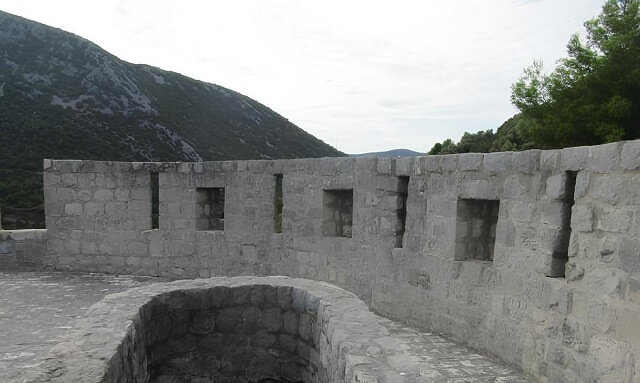
The next section of the wall is perhaps the most difficult to climb. Here, there’s the greatest slope on the ascent, and the width of the walls in this place is quite small.
The towers here are no longer as large compared to the section we passed, but they occur more often, and later I lost count of how many we passed. Although, it seems, there are about forty of them.
Due to the fact that this section of the wall is quite narrow, with people moving in the opposite direction from Mali Ston, you have to pass each other, waiting for them at the next tower. But thanks to this, you can catch your breath.
On this section there’s the greatest slope on the ascent, and the width of the walls in this place is quite small
When we were just preparing for the trip, I read somewhere that you can calmly walk along the entire wall without climbing on it. So, I responsibly declare that if you decided to do this, you need at least mountaineering training and appropriate accessories.
We, meanwhile, climb higher and higher. It’s hard not to be amazed at how in those distant times, with almost complete absence of appropriate equipment, all these stones from which the wall is built were lifted to such a height.
Meanwhile, we approached the final section of the ascent. It will be easier ahead. In addition, in this place, the small wall that rises on the right, in the direction of our movement, protects from the sun shining just from that side.
When we took our walk along the wall, the sun was covered by clouds, but in case of hot, sunny weather, such a wall won’t be superfluous.
The final section of the ascent – it will be easier ahead
At this place, I decided to check what height we had climbed to. It turned out that the elevation gain was just over 150 meters.
The highest point in this defensive complex is located, judging by the maps, at a height of about 250 meters. But there, a section of the wall rises, passage along which is prohibited.
But overall, a walk along this wall still requires certain physical fitness.
And there, in the distance, the other part of the isthmus appeared. The one where Mali Ston is located, situated on the shore of the Neretva Bay – the final point of our route. A little further you can see how the walls gradually descend in its direction.
The walls gradually descend in the direction of the town of Mali Ston – the final point of our journey
The pedestrian section of the wall stretched to the Koruna fortress, which is located, as it were, above Mali Ston. It’s already visible in the distance, and beyond the Neretva Bay you can see the main, mainland part of Croatia.
From the place where we are currently located, if you look closely, you can see a bridge thrown across one of the smaller bays. This is the Bistrina bridge. The Adriatic Highway runs along it, stretching along the entire Croatian coast.
A little to the north (and if you look at the photo, to the left), the highway crosses the border with Bosnia, which in this place has a small, and only, exit to the Adriatic Sea. Actually, because of this exit, Southern Dalmatia, to which Pelješac belongs, is an enclave.
Neretva Bay and Bistrina bridge
And here’s the Koruna fortress (or fort), in a larger view. You couldn’t visit it, as you can see, at that time restoration work was being carried out there.
In the photo below, you can see the staircase closed to tourists leading to the Koruna fortress. We turned left, according to the sign.
Having descended along the fortress walls, we soon came out in Mali Ston, completing our journey along the Great Croatian Wall, which took us about an hour and a half.
Koruna fortress (or fort)
Next, you can descend from the wall and walk through the oyster capital of Croatia, Mali Ston. Getting ahead of myself, the town made a very pleasant impression on me, and I liked it even more than Veliki Ston.
Summing up our walk, I can say that it was a very vivid impression that met my expectations 100 percent.
Despite the not very easy climb, the high air temperature (although, to be fair, that day couldn’t be called really hot), the visit to the Great Croatian Wall caused us genuine delight. Although initially we strongly doubted the expediency of such a walk.
So if you’re in those parts and get the opportunity to take a day trip to Ston, I definitely recommend walking along this wall, but already taking into account those nuances that I talked about above.
Private tour from Dubrovnik to Ston, with a visit to the Great Croatian Wall, can be found at this link.
Bonus
While walking along the restored part of the wall, we came across such a semi-ruined chapel. We looked inside, and there were coffins. I wanted to check what was inside, but I changed my mind (what if a nervous zombie jumps out?).
Chapel with coffins on the restored part of the wall
Did you like the article?
Share it with your friends: